
About the British Trolleybus Society
Our Origins
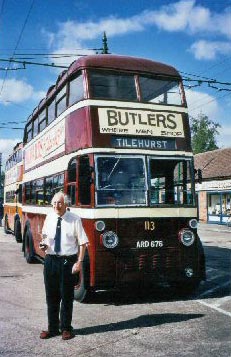
Our Origins In April 1961. fourteen trolleybus enthusiasts met together to create the Reading Transport Society (RTS), initially with the objective of buying a vintage 1939 AEC trolleybus which was due to be retired by Reading Corporation Transport (RCT) later that year. Their dream was realised in September 1961 when RCT trolleybus 113 was successfully purchased for preservation, the first trolleybus in Britain to be privately preserved. Although the RTS was established as a local Society, membership spread nationwide rapidly.
With trolleybuses fast disappearing from UK streets in the 1960s it was not long before other trolleybuses were added to the preserved fleet which was kept in outside storage at a coach depot in the south of Reading. South Shields 204, Bournemouth 99 and Cardiff 203 had joined Reading 113 by 1964. Tours of the remaining systems were arranged for members and the strength of the Society membership was such that it set about trying to convince the remaining UK trolleybus operators that trolleybuses were worth retaining, particularly for environmental reasons. Sadly, this was not a priority at that time and all systems were closed by 1972.
Our Evolution
Against a background of trolleybus systems being abandoned at an alarming rate and the number of trolleybuses in preservation growing rapidly, the search was on to find suitable land in which to build an operational trolleybus museum to run the preserved fleet. The breakthrough came in 1969 when an old airfield at Sandtoft (between Doncaster and Scunthorpe) was purchased and, with the involvement of other transport enthusiast groups, the Trolleybus Museum at Sandtoft was born. At the same time we expanded our horizons and introduced a regular report on trolleybus developments throughout the world in our journal Trolleybus.
The last trolleybus to operate in public service within the UK ran in Bradford in March 1972 but it was only a matter of a few months after that the first trolleybus ran at Sandtoft. Since that time our Society has played a full part in the growth of the Trolleybus Museum at Sandtoft, a museum held in high regard throughout the bus enthusiast circle as well as by educational establishments.
It was increasingly evident that the name of the Society did not reflect the national scope of its work and its specific focus on trolleybuses. Following a Members’ competition and a subsequent ballot, the Reading Transport Society became the British Trolleybus Society on 29 April 1971.
Anniversaries
Significant anniversaries are an opportunity to showcase our vehicles. To celebrate our 45th anniversary and to commemorate 70 years since trolleybuses commenced operations in Reading, we staged a very successful ‘Reading Trolleybuses Recalled’ event at the Trolleybus Museum at Sandtoft over the Spring Bank Holiday 2006.where we managed to operate five vintage Reading trolleybuses together with 6 contemporary Reading motorbuses. At the Museum’s 40th anniversary in 2009, seven of the 17 trolleybuses operated that weekend were from the BTS fleet. In 2011 the British Trolleybus Society celebrated its 50th anniversary with many events taking place between April and July that year. This was repeated in 2022 (a year later due to the Covid pandemic) for our 60th anniversary.
Today
Our trolleybus fleet is gradually being restored with, so far, Reading 113, Glasgow TB78, London 1812, Bournemouth 99,South Shields 204, Cardiff 203, Manchester 1344, Walsall 872 and Huddersfield 631. Bournemouth 301 is the latest vehicle currently being restored.
In 2017 we purchased additional land at Sandtoft in conjuction with the TM@S and plans are now in hand to expand the museum significantly over the next 10 years. This land purchase also ensures a long term fuure for our preserved trolleybus fleet.